Fairlawn Falls and Dunsinane Falls: Waterfalls of Sri Lanka’s Old Tea Country
Fairlawn Falls and Dunsinane Falls | There are parts of Sri Lanka’s central highlands where the road still seems to belong more to the plantations than to the modern traveller.Beyond Hatton, Maskeliya and the better-known viewpoints, narrow estate roads climb through tea, disappear into mist and cross streams that have been running down these hills long before the first coffee or tea bush was planted.Two waterfalls found in this landscape ,Fairlawn Falls near Upcot and Dunsinane Falls at Pundaluoya are very different in scale, yet both are inseparable from the old plantation country around them.Fairlawn is quiet and easily overlooked. Dunsinane is far larger and more dramatic. What connects them is the landscape: estate roads, old bridges, tea-covered slopes and the waterways that helped shape life in the hills.
Fairlawn Falls, Upcot
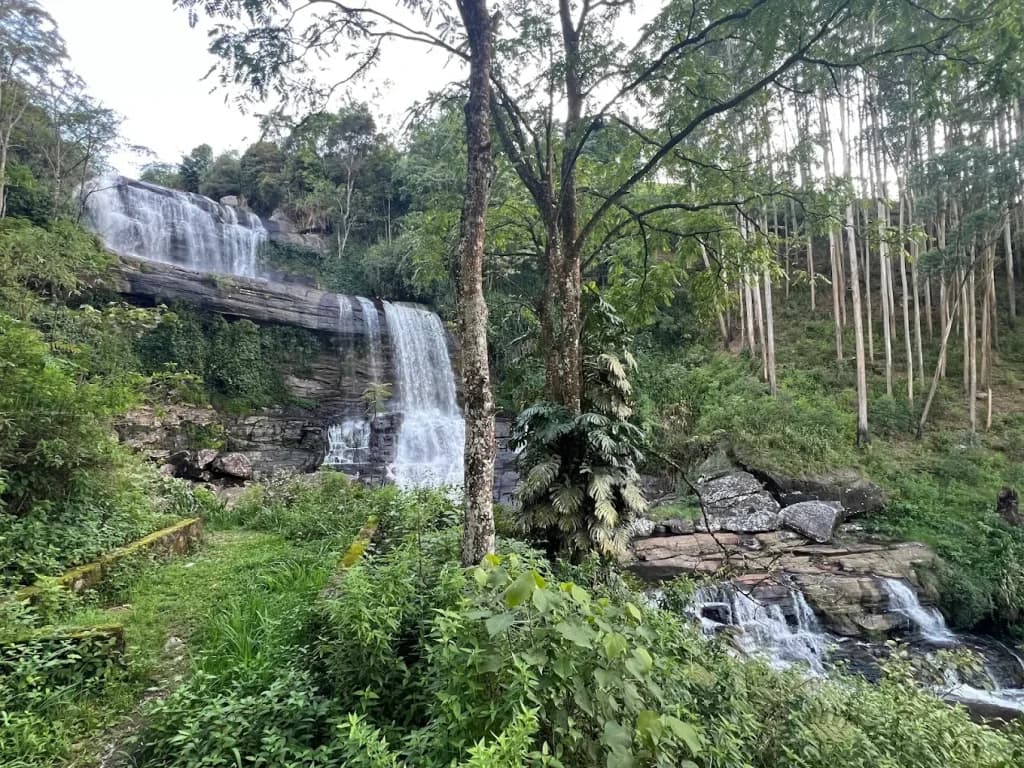
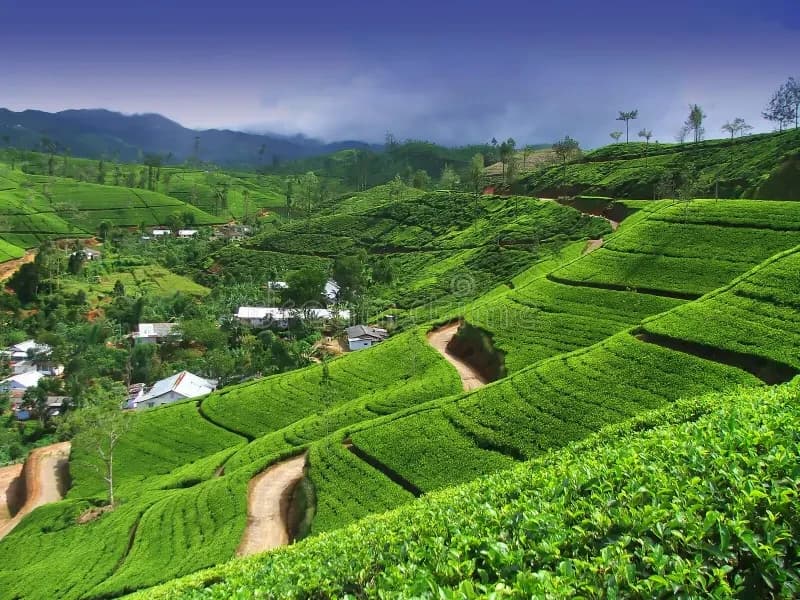
Upcot, or Samimale as the area is also known, lies beyond Norwood in the Maskeliya country. It is a district of steep tea slopes and old estates, with roads that twist between valleys rather than following any obvious straight route.Fairlawn Falls lies within Fairlawn Estate, not far from Upcot.The waterfall is formed by water flowing through the upper reaches of the estate towards the Maskeliya Oya system. Older descriptions differ considerably over its measured height. One waterfall survey described the principal rock barrier as only around four or five metres, while later observations note that the water actually descends through several stages, giving the complete formation a height closer to 15 metres.
That discrepancy makes sense when the waterfall is seen rather than simply measured.Fairlawn is not a single clean vertical drop. The water moves over a succession of shelves and inclined rock surfaces, breaking into smaller cascades before continuing downstream.The photograph of the falls captures this character particularly well. Instead of a sheer cliff, the stream spreads across a broad, stepped bed of rock. Above it stands an estate bridge, dark against the pale water below, while tea-covered slopes rise on either side.It looks less like a formal tourist attraction and more like part of the working landscape.And that is essentially what it is.
An Estate Landscape Rather Than a Tourist Site
Fairlawn has never developed the roadside fame of Devon Falls, St Clair’s or Ramboda. Reaching it traditionally meant entering plantation country and following estate roads beyond Upcot.A route recorded in a guide to Sri Lankan waterfalls runs from Norwood towards Upcot and then along the Maskeliya Oya towards Meeracotta. Modern accounts similarly describe reaching the waterfall through Fairlawn Estate before making a short descent from the estate road.The estate itself belongs to an old planting district.Fairlawn appears in colonial-era records well before independence. A 1920 Ceylon Government Gazette dealing with road contributions lists Fairlawn Estate under the Fairlawn Estate Company, alongside neighbouring properties such as Suriakanda, Glencoe, Mincing Lane, Upcot and Strathspey.
Those names still form part of the geography of this corner of the hills.Even the waterfall entered the memories of the planting community. Writing about his time in the Maskeliya-Upcot district during the 1960s, former planter David Bretherton recalled stocking the Maskeliya Oya with trout fingerlings in what was known as the Fairlawn Pool, at the top of the large waterfall on the estate.It is a small detail, but an evocative one.The waterfall was not merely scenery. It belonged to the everyday geography of estate life.
Water Among the Tea
The character of Fairlawn changes considerably with rainfall.When the stream is full, water spreads across the rock in white layers. During quieter periods, the structure underneath becomes more obvious , ledges, channels and pools worn into the stone.The surrounding vegetation almost closes around it.Tea occupies the cultivated slopes, while thicker growth gathers beside the watercourse. In mist or light rain, the bridge and the green hills beyond can appear almost suspended above the cascade.There is nothing monumental about Fairlawn Falls.
Its appeal lies precisely in that absence of spectacle.It is one of those places where the plantation landscape and the natural landscape have become so closely interwoven that separating the two is difficult.
Dunsinane Falls, Pundaluoya
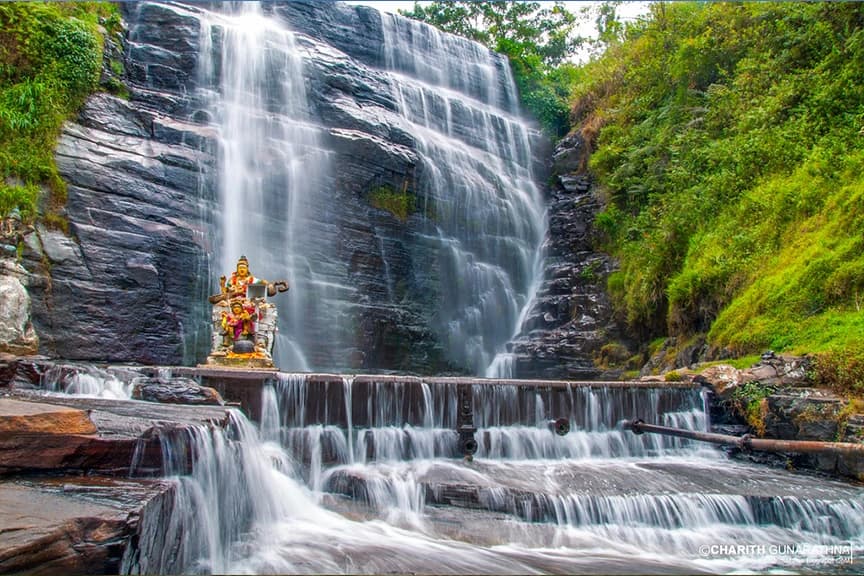
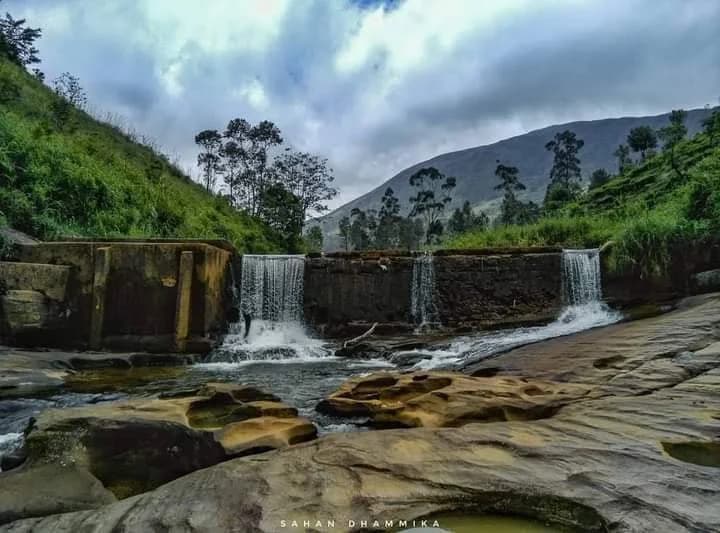
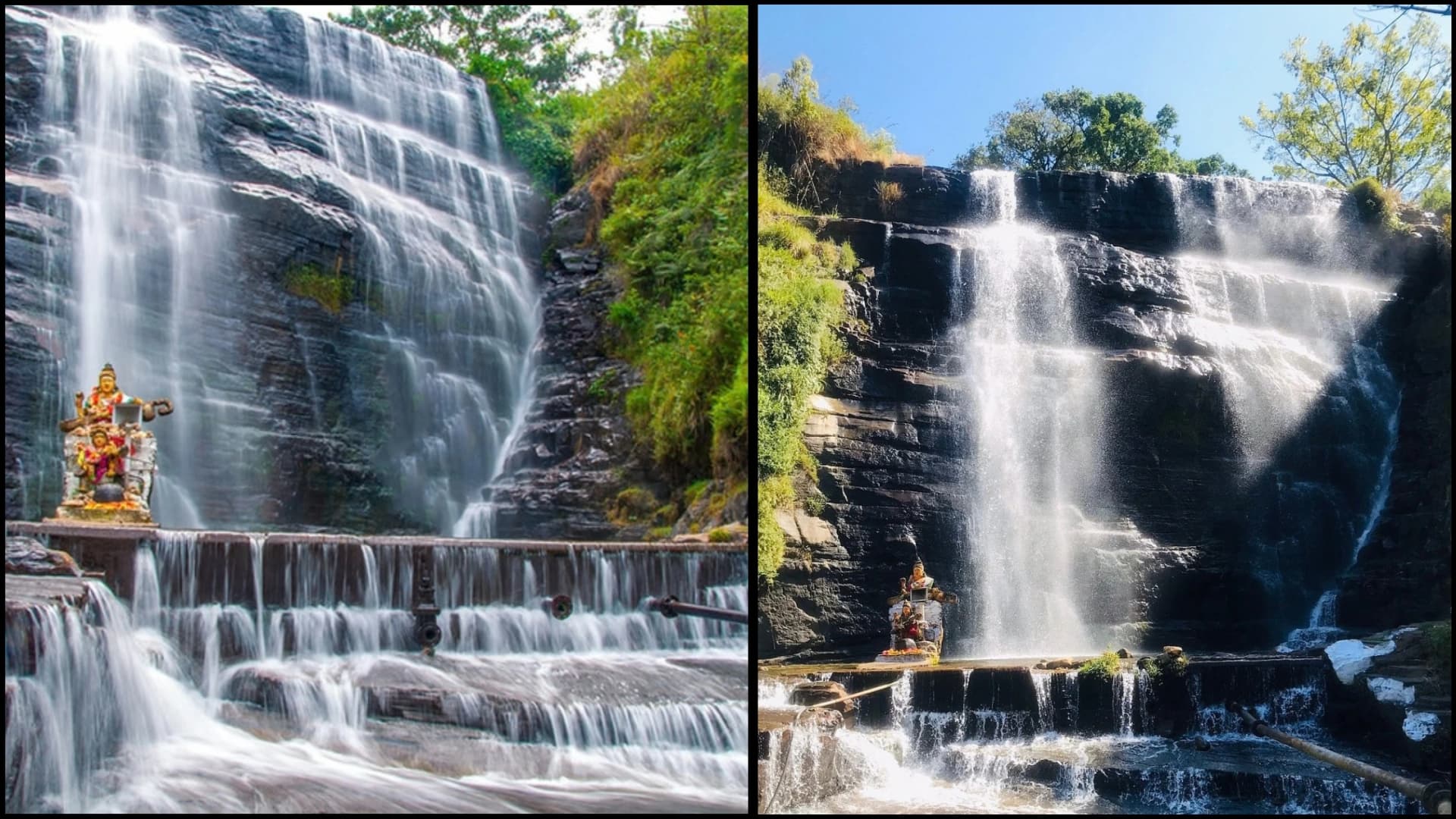
Dunsinane is another matter entirely.Travel into the Pundaluoya Valley and the scale changes dramatically.Here the Pundalu Oya descends through a major waterfall system usually known as Dunsinane Falls, Dunsinane-Sheen Falls or Pundalu Oya Falls. It lies between Dunsinane and Sheen estates in the Nuwara Eliya District.The accepted height is approximately 100 metres.But even that figure does not immediately explain what the traveller sees.Dunsinane is divided by a road bridge.
Above the bridge, the river crosses a broad rock face and drops roughly 30 metres through a sequence of ledges. Below the road is the much larger lower section, descending another approximately 70 metres into the valley. The lower fall is considerably harder to see properly because of the steep terrain.This unusual arrangement makes Dunsinane one of Sri Lanka’s most interesting road-crossed waterfalls.The road does not simply pass the waterfall.It cuts through it.
The Falls Seen From the Estate Road
The photographs show why Dunsinane can look different from one viewpoint to another.From close range, water drops over a dark wall of layered rock, gathering into narrow white curtains before breaking apart on the ledges below. Elsewhere the fall widens, revealing several smaller channels working their way through the same rock face.After heavy rain, those separate channels merge and much of the stone disappears beneath white water.Vegetation grows directly against the cliffs, softening the edges of the waterfall. Tea country begins beyond it.Unlike Fairlawn, where water seems to wander through the landscape, Dunsinane appears to cut through it.Yet the most impressive part is partly concealed.
A visitor stopping at the bridge sees principally the upper waterfall. Far below lies the much longer second descent, hidden by the abrupt fall of the valley.There is therefore no single roadside viewpoint from which the complete 100-metre waterfall presents itself neatly.Dunsinane has to be understood in sections.
A Name From the Plantation Era
The name is itself part of the history of the district.Dunsinane Estate occupies one side of the waterfall and Sheen Estate the other, which explains the older combined name Dunsinane-Sheen Falls. The river forming it is the Pundalu Oya, which eventually joins the Kotmale river system.Dunsinane Estate has deep roots in Ceylon’s plantation history.Industry records trace activity on the property back into the coffee era. One historical account credits George Smyttan Duff with opening Dunsinane for coffee cultivation during the 1840s; later estate histories place its development as a major tea property in the nineteenth century.That history matters when looking at the valley today.The tea fields, estate divisions, roads, bridges and factories are not recent additions placed beside the waterfall. They are the accumulated result of more than a century of plantation settlement.Dunsinane Falls survived in the middle of that transformation.
Fairlawn Falls and Dunsinane Falls | Pundaluoya Beyond the Main Tourist Road
Pundaluoya itself remains somewhat outside the standard Nuwara Eliya itinerary.Most visitors travelling through the central highlands follow the main roads between Kandy, Ramboda, Nuwara Eliya, Talawakele and Hatton. Pundaluoya lies within another network of valleys and estate roads.That relative isolation has preserved a very different atmosphere.There are tea factories, line settlements, temples, bridges and old estate names scattered across the hills. Clouds descend quickly. A sunny ridge can disappear into rain within minutes.Dunsinane belongs naturally to this setting.There is even a Hindu place of worship beside the waterfall, another reminder that these landscapes are lived-in places rather than empty scenery created for tourism.
Two Falls, Two Faces of the Tea Country
Fairlawn and Dunsinane should not really be compared by height.Dunsinane wins that contest without difficulty.What makes travelling to both worthwhile is the contrast.At Fairlawn, water descends gently across a staircase of rock beneath an estate bridge. The waterfall feels intimate and enclosed by tea and vegetation.At Dunsinane, the landscape opens vertically. Water plunges down an enormous rock formation before disappearing below the road into the valley.One can almost be missed.The other is difficult to ignore.yet both tell the same larger story.
Long before these hills became associated around the world with Ceylon tea, streams were cutting their courses through the mountains. Then came roads, plantations, factories, bungalows and bridges. The waterways remained, sometimes beside the estates and sometimes running straight through them.Fairlawn Falls and Dunsinane Falls are surviving pieces of that landscape.They are not polished attractions separated from their surroundings. To understand them properly, the journey through Upcot and Pundaluoya matters just as much as the moment of reaching the water.And perhaps that is the best reason to seek them out.The central highlands still contain places where the old estate road, the tea field, the mist and the waterfall remain part of the same view.
Visit us: https://trippingsrilanka.com/stories